Read an online article saying that this is the 7th official mural commissioned by Sibu Municipal Council (SMC), but as far as my calculation is concerned... this should be the 6th. Can't find any reliable information about the 6th mural, so I'll follow my own tracking..
This 6th mural is about Kiu Chiong Loi who is operating Diang Miang Ngu's stall at the little alleyway near Blacksmith Road for more than half a century.
Chop Hing Huong is the name of the stall and the mural is at the same alleyway with just few steps away from it. To know more about Chop Hing Huong and Diang Miang Ngu, you can read my previous post about it.
The artist who produced this drawing is Branden Tiong, a renowned Sibu videographer cum photographer. He finished the artwork around February this year.
This mural shared the same problem as the previous one where the alleyway become motorcycles parking area during day time thus it's hard to take a clear shot of this mural.
At this moment of writing, this bowl of Diang Miang Ngu priced at RM 4/bowl. In earlier days, the same serving can cost as cheap as less than a Ringgit to two.
This is a comparison of the real life photo with the wall painting.
Showing posts with label Street Art. Show all posts
Saturday, April 9, 2016
Thursday, March 10, 2016
5th Mural - 70's Sibu Bus Station & The Green-White Bus
The 5th mural commissioned by Sibu Municipal Council (SMC) has been drawn on the wall at an alleyway at Blacksmith Road during December last year and this time it is titled an old-school bus.
Some may wonder the significance of an old-school bus at such venue? Those knew the history of Sibu should know the reason.
[Photo taken from the Internet showing the current Butterfly Garden which was the venue of Sibu bus station in 70s]
The green-white old school bus has significant meaning at this area as the current "Butterfly Garden" which is linked to Blacksmith Road through this alleyway was once the venue of Sibu bus station during 70s. At that time, these type of buses were one of the main public transport in town.
Butterfly Garden is the venue of current night market a.k.a. pasar malam and it is a parking space during day time.
This mural was drawn by a popular Sibu figure, Edmund Wong, who is a performer as well as a famous bestman for wedding.
There is an issue having mural at this alleyway as at day time, this place has become a motorcycles parking area which blocking the view of the mural.
If that's the case then there is no point of having mural which the main objective is to boost Sibu tourism especially for Sibu Visit Year 2017.
Visitors will not be able to snap a clean shot with the mural when there are other objects blocking the view which may cause great disappointment for the visitors.
Sunday, October 18, 2015
Childhood - 4th Offical Mural @ Sibu Central Market
Do you still remember how's your childhood is all about?? If not, the mural titled "Childhood" located at Sibu Central Market level 2 may help you recall some of your childhood memories especially those born in the pre digital age.
This is the 4th official wall arts initiated by Sibu Municipal Council and the 2nd within Sibu Central Market building compound. Before this we have wharf labourer at Jalan Khoo Peng Long, local delicacies series at Jalan Market and wrapped chicken and duck at Sibu Central Market facing Jalan Bengkel's direction.
The most recent mural is located on the wall at eatery section, near to the cloth stalls of Sibu Central Market 2nd floor. It lively illustrated the childhood life around 80's where Internet and digital devices were still absence in our life.
At that time children were playing with toys made of metal or rubber, enjoy the fun of folding paper plane and see whose can fly furthest. Tic-Tac-Toe game is not in digital form, one needs to get a paper, then draw the boxes in order to play the game or the easiest way will be tearing down mathematics exercise book where the boxes are ready drawn!
The wealthier families may allow their children to own a handheld gaming device where Nintendo's Game & Watch was among the most popular at the time. Electronic gaming was pretty primitive at that era where the the device screen is small, monochrome, simple "graphics", less responsive, static and unchangeable game's background as well as very limited movement of the character in the game, normally just 4-5 steps horizontally and the more advanced one may allow vertical movement. Owning one of such device will make the person an idol among their buddies.
One problem of this mural in my personal opinion is the location. As it is located at the eatery section, the tables placed at this area have blocked the view. Another thing is when the tables are occupied during eating peak hours, it may stop people or visitors from taking memorable photos with the mural and for that, the mural couldn't serve its purpose to the fullest.
There are more to explore on this wall painting about childhood life and I'll leave it to you all. I personally like this painting a lot... the best among the 4 murals by SMC Sibu, but I don't like the location.
This is the 4th official wall arts initiated by Sibu Municipal Council and the 2nd within Sibu Central Market building compound. Before this we have wharf labourer at Jalan Khoo Peng Long, local delicacies series at Jalan Market and wrapped chicken and duck at Sibu Central Market facing Jalan Bengkel's direction.
The most recent mural is located on the wall at eatery section, near to the cloth stalls of Sibu Central Market 2nd floor. It lively illustrated the childhood life around 80's where Internet and digital devices were still absence in our life.
At that time children were playing with toys made of metal or rubber, enjoy the fun of folding paper plane and see whose can fly furthest. Tic-Tac-Toe game is not in digital form, one needs to get a paper, then draw the boxes in order to play the game or the easiest way will be tearing down mathematics exercise book where the boxes are ready drawn!
The wealthier families may allow their children to own a handheld gaming device where Nintendo's Game & Watch was among the most popular at the time. Electronic gaming was pretty primitive at that era where the the device screen is small, monochrome, simple "graphics", less responsive, static and unchangeable game's background as well as very limited movement of the character in the game, normally just 4-5 steps horizontally and the more advanced one may allow vertical movement. Owning one of such device will make the person an idol among their buddies.
One problem of this mural in my personal opinion is the location. As it is located at the eatery section, the tables placed at this area have blocked the view. Another thing is when the tables are occupied during eating peak hours, it may stop people or visitors from taking memorable photos with the mural and for that, the mural couldn't serve its purpose to the fullest.
There are more to explore on this wall painting about childhood life and I'll leave it to you all. I personally like this painting a lot... the best among the 4 murals by SMC Sibu, but I don't like the location.
Sunday, August 16, 2015
Wrapped Chicken as the 3rd Official Mural @ Sibu Central Market
Until this moment of writing, the town of Swan, Sibu has totally 3 official murals by the local council. The very 1st mural is a painting about wharf labourer at Jalan Khoo Peng Long and the 2nd one is a series of local delicacies of different ethnics located at Jalan Market.
The 3rd one is a mural located at the venue sort of "in between" the previous 2 murals and at one of the most lively and happening spot of Sibu town - Sibu Central Market @ Jalan Channel. It is about a very unique "scenery" that one can experience when visiting to one of the largest centralized market in the country which is the wrapped chickens and ducks.
This is how the hawkers here selling live chickens or ducks, by wrapping them in tube form using newspapers, then tied with nylon string to form sort of "handle" by leaving the birds' heads protruding at one end before putting them on shelves for selling.
Wrapping the birds in this way have few advantages:
To be honest, as a Siburian who grown up in this town, I never aware of the uniqueness of such method of wrapping the live chickens until I saw some reports/articles/blog posts highlight about this scenario. For me it is something that I used to see since I was a kid and it is just a norm but obviously it is not the same case in the eyes of the outsiders or foreign visitors.
This explained why the 3rd mural of SMC is about this wrapped chickens/ducks and located at the Central Market's building. It's because of its uniqueness in the eyes of tourists and became one of the "selling point" for visiting this large centralized market.
The painting is at the wall facing Jalan Bengkel, just opposite local corporate Pansar's office building. It consists of a long bench, with few wrapped chickens on and under the bench on the left and a wrapped duck on the right. Apart from these, there are 2 empty speech bubbles, one pointing to one of the chicken and another pointing to the empty bench area.
So, you can use your creativity and imagination how and what to pose with the painting to make it more "meaningful". However, I personally feel that it is not a good spot for the mural for following reasons:
The 3rd one is a mural located at the venue sort of "in between" the previous 2 murals and at one of the most lively and happening spot of Sibu town - Sibu Central Market @ Jalan Channel. It is about a very unique "scenery" that one can experience when visiting to one of the largest centralized market in the country which is the wrapped chickens and ducks.
This is how the hawkers here selling live chickens or ducks, by wrapping them in tube form using newspapers, then tied with nylon string to form sort of "handle" by leaving the birds' heads protruding at one end before putting them on shelves for selling.
Wrapping the birds in this way have few advantages:
- the buyers can easily carry it away (time saving) just like carrying a handbag (that's why some people said it is a chicken "handbag")
- sellers can display the birds on rack to let buyers to see, choose and feel the birds before buying them (harder to choose if put inside the cage)
- can prevent droppings from messed up the floor, the road and the cloth
- the birds are calm and more comfortable at such position (imagine if put the birds in plastic bag, they may suffocated)
To be honest, as a Siburian who grown up in this town, I never aware of the uniqueness of such method of wrapping the live chickens until I saw some reports/articles/blog posts highlight about this scenario. For me it is something that I used to see since I was a kid and it is just a norm but obviously it is not the same case in the eyes of the outsiders or foreign visitors.
This explained why the 3rd mural of SMC is about this wrapped chickens/ducks and located at the Central Market's building. It's because of its uniqueness in the eyes of tourists and became one of the "selling point" for visiting this large centralized market.
The painting is at the wall facing Jalan Bengkel, just opposite local corporate Pansar's office building. It consists of a long bench, with few wrapped chickens on and under the bench on the left and a wrapped duck on the right. Apart from these, there are 2 empty speech bubbles, one pointing to one of the chicken and another pointing to the empty bench area.
So, you can use your creativity and imagination how and what to pose with the painting to make it more "meaningful". However, I personally feel that it is not a good spot for the mural for following reasons:
- The space in front of the mural always occupied and parked with motorcycles, thus the view always get blocked.
- Some people used to take a rest at that area after shopping at central market while waiting for transport (especially during weekend), thus block the view and visitors may not be able to take photo with the mural.
Monday, July 27, 2015
6 Local Delicacies for 2nd Official Mural @ Jalan Market
The theme for the 2nd official mural street arts by the Sibu Municipal Council is a series of local delicacies from different ethnics and races in the Swan city of Sibu.
They are located at an alleyway at Jalan Market, which is one of the busiest and most lively old street witnessing the growth of Sibu town. Jalan Market was once the venue of Sibu centralized wet market but then been demolished in year 2002 for whatever purposes. It was also where the pasar malam (night market) is located before it was moved to the current location at butterfly's park.
The street art was painted on the side wall of Tai Kiong Emporium with the special permission from the owner. As mentioned earlier it is about a series of local delicacies of Sibu from multi-racial society here which one should never miss when visiting the town. These local delicacies are: Kampua Mee, Diang Miang Ngu/ Dian Bian Hu, Kompia from Chinese ethnic, Pulut Panggang, Penyeram and Kuih Jala from Iban, Malay and Melanau.
Kampua Mee
Kampua is a dry-tossed noodles with lard, soya sauce and MSG or more commonly known as "Ajinomoto" then garnish with spring onion, deep fried shallots and also few slices of pork which have been dyeing red on the surface layer.
It is one of the most favorite food of Siburians and you can easily get it at any kopitiam in Sibu.... yes... I say any... because a kopitiam without the stall selling Kampua can hardly survive as it is always the top choice of Siburians for breakfast and supper.
If you wish to read more about this delicacy... you can refer to my previous posts about it:
1. Kampua @ Sing Hin Corner
2. Kampua @ Rasa Sayang Cafe
3. Curry Kampua @ Lane 13 Seafoods Coffee Shop (This stall was moved to some other places)
Diang Miang Ngu
Some translated it as Diang Bian Hu or Dian Bian Hu or whatever but the name is originated from Foochow accent.It actually means "the rice starch paste from the wok side" which is related to how this cuisine is been prepared.
The cooked rice starch paste are served in pork broth together with black fungus, fish balls, pork and squids, garnish with spring onion. This is one of the specialty delicacy of Sibu but it can only been found at few limited spots with the most authentic one located at an alleyway between the Blacksmith Road and Butterfly Park.
Related posts about Diang Miang Ngu on this blog:
1. Famous Sibu Diang Miang Ngu @ The Little Alleyway
2. Breakfast @ My Corner - Curry Diang Miang Ngu + Pan Mee
Kompia
Kompia is a bread product by Foochow ethnic which is made of simple ingredients such as flour, salt, water and baking soda. The prepared dough will be flatten to a disc shape, then a tiny hole is punched at the center of each bun before sesame seeds been spread over them. The buns will then been pasted into the wall of the clay oven heated with hot-burnt charcoal at its bottom.
Yes. It may sound simple yet it is unbelievably addictive especially when they're fresh from oven. Kompia texture is soft but very chewy. The side that pasted to the oven wall during the baking process is a little bit crunchy when they're still hot.
Kompia can be eaten plain for its original taste, or some people prefer to re-process it before serving to add more flavor such as stuff it with minced/stewed pork, fried it before add stuffing or soak it inside special made gravy.
Pulut Panggang
Pulut panggang is a well-known Malay pastry that is generally loved by most people regardless of races. It is made of glutinous rice which is cooked with coconut milk and little salt, then these rice are rolled and wrapped in a special banana leaf before they're grilled or barbequed on burning charcoal.
Pulut panggang in Sibu normally is the one without filling. However, the variant with shrimp floss as filling can also be found but rare. Pulut panggang is best be taken as breakfast or as snack during tea time.
Penyaram
Penyaram or Penyeram is a very unique pastry some said originated from Iban but some claimed it is from Malay. Its unique shape has giving it variety of nicknames. Some called it Mexican hat and some called it kuih UFO and I have friend who even said it looks like abalone!!
Ingredients for making penyaram is very simple, just flour, palm sugar and water. However, the production process is very challenging and requires high skills. You need to have a small wok which has deep dome shape at the middle because that's where the pastry get its shape later. Then you need to fry the batter one after another using slow heat and it is time consuming.
The texture of this pastry is also very unique. Middle part is soft and spongy with the edge is curly and crispy. It is not too sweet and with strong palm sugar aroma. Personally love this pastry a lot!
Kuih Jala
Jala means net in Malay or Iban language. So Kuih Jala can be literally translated as net pastry or the pastry that have netting structure.
It is an Iban's traditional snack and the process of producing this delicacy is kind of interesting and need the right tools and skills.
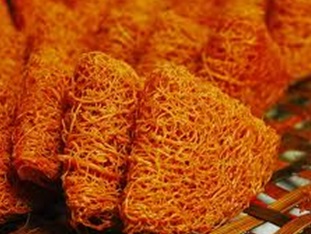
The flour mixture is poured through a mould made of halved coconut shell with tiny punched holes in it into the hot oil and make it a round shape until the right thickness. It'll then been fold half or quarter while still in the hot oil.
Kuih Jala is super crispy and sweet in taste. It is nice to eat as snacks during tea time. As the preparing and producing process aren't easy, thus it is harder to find on the market.
They are located at an alleyway at Jalan Market, which is one of the busiest and most lively old street witnessing the growth of Sibu town. Jalan Market was once the venue of Sibu centralized wet market but then been demolished in year 2002 for whatever purposes. It was also where the pasar malam (night market) is located before it was moved to the current location at butterfly's park.
The street art was painted on the side wall of Tai Kiong Emporium with the special permission from the owner. As mentioned earlier it is about a series of local delicacies of Sibu from multi-racial society here which one should never miss when visiting the town. These local delicacies are: Kampua Mee, Diang Miang Ngu/ Dian Bian Hu, Kompia from Chinese ethnic, Pulut Panggang, Penyeram and Kuih Jala from Iban, Malay and Melanau.
Kampua Mee
Kampua is a dry-tossed noodles with lard, soya sauce and MSG or more commonly known as "Ajinomoto" then garnish with spring onion, deep fried shallots and also few slices of pork which have been dyeing red on the surface layer.
It is one of the most favorite food of Siburians and you can easily get it at any kopitiam in Sibu.... yes... I say any... because a kopitiam without the stall selling Kampua can hardly survive as it is always the top choice of Siburians for breakfast and supper.
If you wish to read more about this delicacy... you can refer to my previous posts about it:
1. Kampua @ Sing Hin Corner
2. Kampua @ Rasa Sayang Cafe
3. Curry Kampua @ Lane 13 Seafoods Coffee Shop (This stall was moved to some other places)
Diang Miang Ngu
Some translated it as Diang Bian Hu or Dian Bian Hu or whatever but the name is originated from Foochow accent.It actually means "the rice starch paste from the wok side" which is related to how this cuisine is been prepared.
The cooked rice starch paste are served in pork broth together with black fungus, fish balls, pork and squids, garnish with spring onion. This is one of the specialty delicacy of Sibu but it can only been found at few limited spots with the most authentic one located at an alleyway between the Blacksmith Road and Butterfly Park.
Related posts about Diang Miang Ngu on this blog:
1. Famous Sibu Diang Miang Ngu @ The Little Alleyway
2. Breakfast @ My Corner - Curry Diang Miang Ngu + Pan Mee
Kompia
Kompia is a bread product by Foochow ethnic which is made of simple ingredients such as flour, salt, water and baking soda. The prepared dough will be flatten to a disc shape, then a tiny hole is punched at the center of each bun before sesame seeds been spread over them. The buns will then been pasted into the wall of the clay oven heated with hot-burnt charcoal at its bottom.
Yes. It may sound simple yet it is unbelievably addictive especially when they're fresh from oven. Kompia texture is soft but very chewy. The side that pasted to the oven wall during the baking process is a little bit crunchy when they're still hot.
Kompia can be eaten plain for its original taste, or some people prefer to re-process it before serving to add more flavor such as stuff it with minced/stewed pork, fried it before add stuffing or soak it inside special made gravy.
Pulut Panggang
Pulut panggang is a well-known Malay pastry that is generally loved by most people regardless of races. It is made of glutinous rice which is cooked with coconut milk and little salt, then these rice are rolled and wrapped in a special banana leaf before they're grilled or barbequed on burning charcoal.
Pulut panggang in Sibu normally is the one without filling. However, the variant with shrimp floss as filling can also be found but rare. Pulut panggang is best be taken as breakfast or as snack during tea time.
Penyaram
Penyaram or Penyeram is a very unique pastry some said originated from Iban but some claimed it is from Malay. Its unique shape has giving it variety of nicknames. Some called it Mexican hat and some called it kuih UFO and I have friend who even said it looks like abalone!!
Ingredients for making penyaram is very simple, just flour, palm sugar and water. However, the production process is very challenging and requires high skills. You need to have a small wok which has deep dome shape at the middle because that's where the pastry get its shape later. Then you need to fry the batter one after another using slow heat and it is time consuming.
The texture of this pastry is also very unique. Middle part is soft and spongy with the edge is curly and crispy. It is not too sweet and with strong palm sugar aroma. Personally love this pastry a lot!
Kuih Jala
Jala means net in Malay or Iban language. So Kuih Jala can be literally translated as net pastry or the pastry that have netting structure.
It is an Iban's traditional snack and the process of producing this delicacy is kind of interesting and need the right tools and skills.
The flour mixture is poured through a mould made of halved coconut shell with tiny punched holes in it into the hot oil and make it a round shape until the right thickness. It'll then been fold half or quarter while still in the hot oil.
Kuih Jala is super crispy and sweet in taste. It is nice to eat as snacks during tea time. As the preparing and producing process aren't easy, thus it is harder to find on the market.
(Photo taken from http://nyamaiamat.weebly.com/process.html)
Tuesday, June 30, 2015
1st Official Street Art Mural @ Jalan Khoo Peng Long Sibu
Since Penang street art mural received overwhelm respond from both local and foreign tourists, now there are more towns within the country starting to follow the step of Penang government as a method to boost their tourism industry.
One of them is my hometown, the town of Swan - Sibu. Recently Sibu Municipal Council (SMC) has kicked off the project of street mural painting at various selected venues. Differ from other places, these murals are done by engaging local artists and the theme for a series of murals are based on Sibu's cultures and lifestyle.
The 1st and the maiden mural been produced in the town was the one that illustrated a wharf coolie/labourer located at Jalan Khoo Peng Loong or currently known as Jalan Khoo Peng Long. This is one of the earliest main road in Sibu town center which is nearest to the mighty Rejang river - the longest river in the country.
When road transport was still in very poor stage in Sarawak in early days, water transport through the Rejang river was once the most important and busiest transportation method that connects various towns in the region. Jalan Khoo Peng Long is where all the wharfs to different parts of the region, such as Kapit, Kanowit, Bintangor, Sarikei and so on was located at those time.
These wharfs had become the transit point for goods and cargo between Sibu and other ports in sarawak, therefore wharf labourers were highly demanded at that time to carry weighty goods such as gunny sack of rice to/from/between cargo ships.
These labourers normally carry the weighty goods on their shoulder and they will bring along a red cloth which was used to cover their head and shoulder before placing the loads on them. This is to prevent direct contact between the rough fabrics with their skin and also as a way to prevent dirt.
There were time when the labourers not feel of using the red cloth, therefore they'll tie it across the waist so that it will not MIA (missing in action). Tying the red cloth hard around the waist somehow seems to give extra strength to the labourers to perform their duty which required plenty of energy. The red cloth also became the fabric to wipe off their sweat after hard works under the hot sun.
Wharf activities at Jalan Khoo Peng Long had slowly dwindled in 1990s following the development of road network which connects more and more towns within the region. Hence, most labourers were gone as well since there were not many job opportunity around anymore.
This is the brief story behind the 1st mural in Sibu town - the wharf coolie or labourer. There are more murals to come and hopefully I can/have motivation to cover each of them one after another. ;)
One of them is my hometown, the town of Swan - Sibu. Recently Sibu Municipal Council (SMC) has kicked off the project of street mural painting at various selected venues. Differ from other places, these murals are done by engaging local artists and the theme for a series of murals are based on Sibu's cultures and lifestyle.
The 1st and the maiden mural been produced in the town was the one that illustrated a wharf coolie/labourer located at Jalan Khoo Peng Loong or currently known as Jalan Khoo Peng Long. This is one of the earliest main road in Sibu town center which is nearest to the mighty Rejang river - the longest river in the country.
When road transport was still in very poor stage in Sarawak in early days, water transport through the Rejang river was once the most important and busiest transportation method that connects various towns in the region. Jalan Khoo Peng Long is where all the wharfs to different parts of the region, such as Kapit, Kanowit, Bintangor, Sarikei and so on was located at those time.
These wharfs had become the transit point for goods and cargo between Sibu and other ports in sarawak, therefore wharf labourers were highly demanded at that time to carry weighty goods such as gunny sack of rice to/from/between cargo ships.
These labourers normally carry the weighty goods on their shoulder and they will bring along a red cloth which was used to cover their head and shoulder before placing the loads on them. This is to prevent direct contact between the rough fabrics with their skin and also as a way to prevent dirt.
There were time when the labourers not feel of using the red cloth, therefore they'll tie it across the waist so that it will not MIA (missing in action). Tying the red cloth hard around the waist somehow seems to give extra strength to the labourers to perform their duty which required plenty of energy. The red cloth also became the fabric to wipe off their sweat after hard works under the hot sun.
Wharf activities at Jalan Khoo Peng Long had slowly dwindled in 1990s following the development of road network which connects more and more towns within the region. Hence, most labourers were gone as well since there were not many job opportunity around anymore.
This is the brief story behind the 1st mural in Sibu town - the wharf coolie or labourer. There are more murals to come and hopefully I can/have motivation to cover each of them one after another. ;)
Subscribe to:
Posts (Atom)